 Photo: Arunachal2007 · CC BY-SA 4.0
Why is Ziro Valley special?
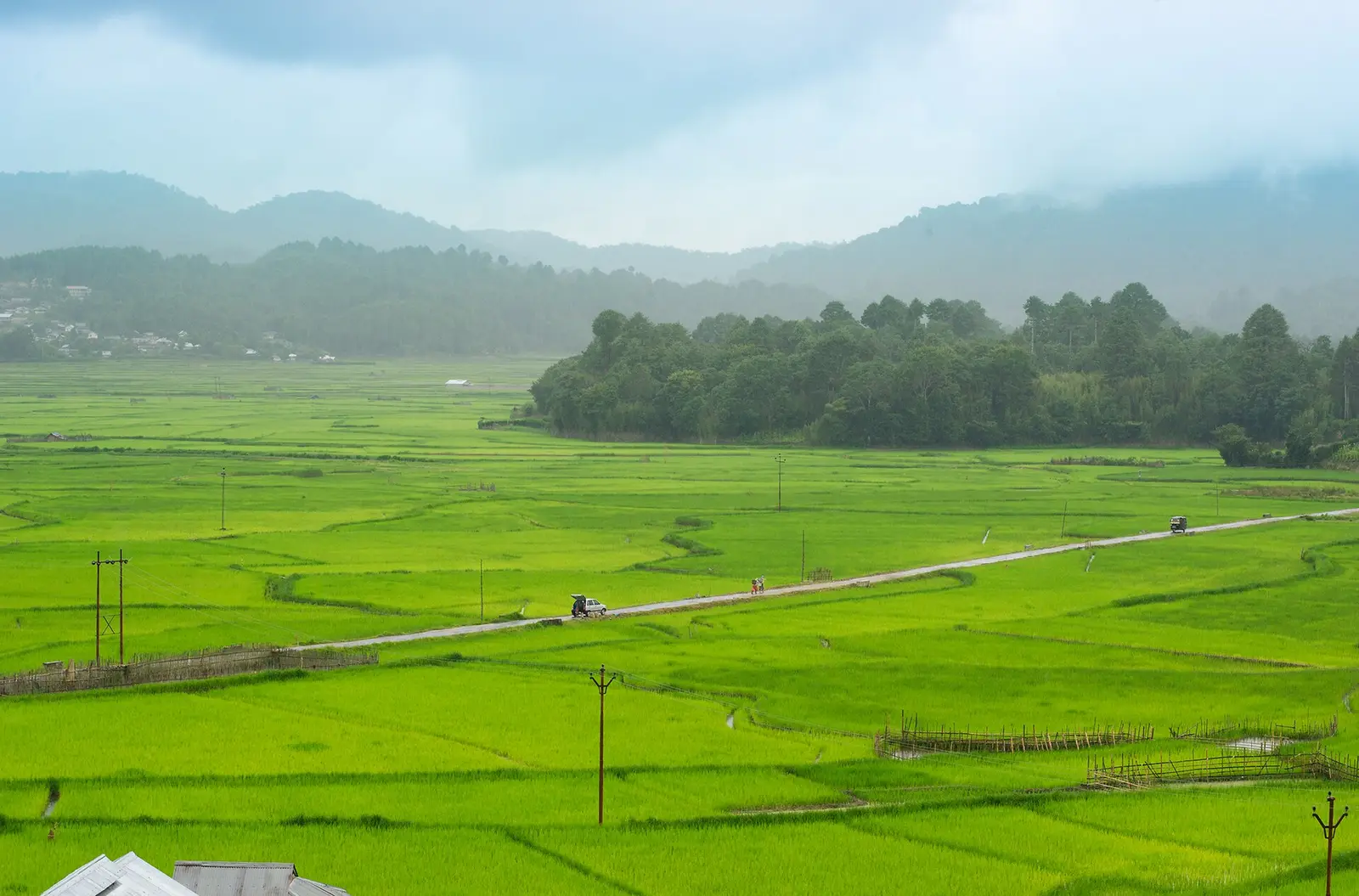
Ziro is a wide, pine-ringed plateau at roughly 1,500–1,700 m in Arunachal Pradesh's Lower Subansiri district, and what makes it special is the Apatani community that farms it. Their system of raising rice and fish together in the same flooded paddies is the reason the Apatani cultural landscape sits on UNESCO's tentative World Heritage list.
Ziro is not a hill station built around viewpoints. It is a working farm valley: flat paddies divided by bamboo fences and stone-lined irrigation channels, clusters of wooden stilt houses, and sacred groves of pine and bamboo on the slopes. Hapoli is the small modern town with markets, petrol and ATMs. The old Apatani villages of Hong, Hari, Bulla, Hija and Dutta are spread across the valley floor a few kilometres away.
Many people first hear of Ziro through the Ziro Festival of Music, an independent music festival held in the fields, usually in late September. But the valley is worth the long journey in most seasons for its walks, its villages and a pace of life that feels very far from Mumbai.
When is the best time to visit Ziro Valley?
The best time to visit Ziro is March to May and September to November, when days are mild and the hill roads are most dependable. Go in September for the music festival, or October for golden paddies just before harvest.
- March–May: Pleasant days, freshly planted fields and Myoko, the Apatani spring festival celebrated in March, with villages taking turns to host.
- June–August: Heavy monsoon. The valley is at its greenest, but landslides can block the approach roads for hours. Dree, the agricultural festival, is held on 5 July.
- September–November: Clear skies, ripening rice and cool evenings. Festival week sells out early, so book stays months ahead if you are going for the music.
- December–February: Cold and dry, with nights near freezing. Quiet and beautiful if you pack thermals; heating in homestays is basic.
How do you reach Ziro Valley from Mumbai?
There is no direct route. You fly from Mumbai to Guwahati, or to Itanagar's Donyi Polo Airport (usually with one stop), and then continue by road. Budget a full day of travel each way and get your Inner Line Permit before you leave home.
Fly to Itanagar
Donyi Polo Airport at Hollongi, near Itanagar, is the closest airport with regular flights. Ziro is roughly 120–150 km away, about 4–5 hours by shared Sumo or private taxi on a winding road. Flights from Mumbai generally connect via Delhi, Kolkata or Guwahati, and schedules shift by season, so compare options on our flight booking page.
Fly to Guwahati, then train or road
Guwahati has the most frequent direct flights from Mumbai, at roughly three and a half hours. From there you can take an overnight train to Naharlagun (the railhead near Itanagar) and a shared Sumo onward, or hire a cab for the whole stretch: about 430 km and 10–12 hours along the north bank of the Brahmaputra.
Via North Lakhimpur, Assam
North Lakhimpur is closer to Ziro than Guwahati, roughly 100–120 km away. Lilabari airport near the town has limited connections. Shared Sumos run up to Ziro from North Lakhimpur in the morning.
Inner Line Permit (ILP)
Indian citizens from outside Arunachal Pradesh need an Inner Line Permit to enter the state. You can apply for an e-ILP online through the state government's portal with photo ID and a photograph; it is valid for a fixed period. Carry printed and digital copies, because it is checked at entry gates. Foreign nationals need a Protected Area Permit instead. Rules and fees change, so check current requirements before you go.
Where should you stay in Ziro?
Stay in an Apatani village homestay for the real experience, or in Hapoli town if you want more predictable hot water and parking. The valley is compact, and most places are 20–30 minutes apart by car.
- Village homestays (Hong, Hari, Siiro, Bulla): Wooden or bamboo houses, home-cooked meals and evenings by the kitchen hearth. Facilities are simple: some have shared bathrooms and bucket hot water.
- Hapoli: Small hotels and guesthouses close to shops, restaurants and ATMs. A practical base if you have a car.
- Festival camping: During the music festival, tent sites come up near the venue. Reserve early.
Expect power cuts and patchy mobile data in places. Carry a power bank and enough cash, since card and UPI acceptance can be uneven outside Hapoli. Homestays usually include breakfast and dinner, which helps, because eating options in the villages are few after dark.
What are the best things to do in Ziro Valley?
The best things to do in Ziro are slow ones: walking between Apatani villages and paddies, visiting the forest shrine at Kardo, hiking to a ridge for valley views and, if your dates line up, joining a festival.
- Village walks in Hong and Hari: Hong is one of the largest Apatani villages. Walk its lanes to see stilt houses, the raised bamboo platforms called lapang where village matters are discussed, and the tall babo poles put up during festivals. A local guide makes the visit far richer and keeps money in the village.
- Paddy-cum-fish fields: Walk the bunds to see how fish are raised in flooded rice fields and how water is shared through bamboo pipes and channels. The government fish farm at Tarin, near Hapoli, shows the system at a larger scale.
- Kardo Siddheshwar Nath temple: A short walk through pine forest leads to a large natural rock lingam, found in 2004 and now a well-known pilgrimage spot.
- Dolo Mando and Kile Pakho: Two short hikes to high points above the valley, with wide views over the paddies and the forested ridges beyond.
- Talley Valley Wildlife Sanctuary: A dense, high-altitude forest about 30 km from Ziro, known for silver fir and orchids. Entry needs forest department permission and a guide, so check access before planning.
- Hapoli market: Good for local produce, bamboo crafts and an easy evening stroll.
What food should you try in Ziro, and how do you travel responsibly?
Try Apatani home cooking: smoked pork, fish from the paddies, bamboo-shoot dishes and local rice beer. And treat the villages as people's homes, not as attractions.
Food to try
- Pike pila: A sharp Apatani pickle of bamboo shoot, chilli and pork fat, eaten with plain rice.
- Paddy fish: Small fish raised in the rice fields, often smoked or cooked in bamboo.
- Smoked pork with bamboo shoot: Simple, smoky and chilli-hot.
- Rice beer: Mild, home-brewed and offered as hospitality. A sip is polite; declining is fine.
- For vegetarians: Homestays will cook rice, dal and seasonal greens if you tell them in advance. Hapoli has a few places serving North Indian basics.
Responsible travel
- Ask before photographing people, rituals or the inside of homes.
- Do not enter sacred groves or ritual sites without a local's go-ahead.
- Stay on the bunds and keep out of the water when fields are being worked.
- Carry your plastic back out; village waste systems are limited.
- Book local guides and homestays so that tourism income stays in the valley.
How many days do you need in Ziro? A sample 3-day plan
Plan three full days in Ziro, plus a travel day at each end. That is enough to see the villages, a forest walk and a viewpoint without rushing.
- Day 1, arrive and settle in: Reach Ziro by afternoon from Itanagar or North Lakhimpur. Check in, walk the fields around your homestay at golden hour, and eat by the hearth.
- Day 2, Apatani villages: Spend the morning in Hong with a local guide, then visit Hari and Bulla. In the afternoon, walk the paddy-cum-fish fields and stop at Tarin. Evening at Hapoli market.
- Day 3, forest and views: Morning at the Kardo Siddheshwar Nath temple, then hike up Dolo Mando or Kile Pakho. If you have permission arranged, spend the afternoon on the road towards Talley Valley.
Ziro combines well with the rest of the North-East. Many travellers add Meghalaya through Guwahati; see our Meghalaya tour package from Mumbai or read our guide to Mawlynnong. Our team can plan Ziro as a custom trip with flights, transfers and permit guidance — send us your dates.