 Photo: Joydeep Chakraborty · CC BY-SA 4.0
Why is Mawlynnong special?
Mawlynnong is a small Khasi village in Meghalaya's East Khasi Hills, known across India as one of the cleanest villages in Asia. Beyond the label, it is a working community where the cleanliness comes from daily habit, not a tourism drive.
The title stuck after a travel magazine called it Asia's cleanest village in the early 2000s, and it has drawn visitors ever since. Walk in and you will notice bamboo dustbins on every lane, swept stone paths, flower-lined front yards and signboards asking you not to litter or smoke. Villagers take turns cleaning common areas, and children grow up doing the same.
The village sits close to the Bangladesh border, on the southern slopes of the Khasi Hills. That location gives it two things most of Meghalaya does not: views over the flat plains of Bangladesh on a clear day, and easy access to the Riwai living root bridge and the Umngot river at Dawki.
The Khasi community is matrilineal, with family names and property passing through the mother's line. You will not see much of this as a visitor, but it is worth knowing as context for the village's social life.
When is the best time to visit Mawlynnong?
October to April is the best time to visit Mawlynnong, with dry trails, clear views and pleasant days of roughly 15–25°C. The monsoon months are greener and more dramatic, but rain can be relentless.
- October–November: post-monsoon green, waterfalls still flowing, clearest skies for the Sky View. The best overall window.
- December–February: cool and dry. Nights get chilly, so carry a light jacket. The Umngot river at Dawki is at its clearest in this period.
- March–May: warmer and still comfortable. Pre-monsoon showers start by May.
- June–September: Meghalaya is among the wettest regions on earth. Expect heavy rain, slippery root bridges and occasional landslides on the roads. Boating at Dawki is often suspended when the river is high.
Long weekends and the Christmas–New Year stretch get busy with day-trippers from Shillong. Arriving in the late afternoon and staying the night lets you see the village after the crowds leave.
How do you reach Mawlynnong from Mumbai?
The simplest route from Mumbai is to fly to Guwahati, then drive about 5–6 hours to Mawlynnong via Shillong. There is no railway in Meghalaya, so road is the only way in.
By air
Non-stop flights from Mumbai to Guwahati take roughly 3.5 hours, and there are also one-stop options via Kolkata or Delhi. Fares rise sharply around Durga Puja, Diwali and December, so book early. Compare Mumbai–Guwahati fares here. Shillong's Umroi airport has a few regional flights, but schedules are limited and change often.
By rail
Guwahati is the nearest major railhead. Trains from Mumbai take well over 40 hours, so most travellers fly.
By road
From Guwahati to Shillong is about 100 km (3–3.5 hours). From Shillong to Mawlynnong is about 80–90 km (2.5–3 hours) via Pynursla. Shared sumos run from Shillong, but they are infrequent, so a private taxi is the practical choice. Most visitors book one cab for the whole Meghalaya circuit.
Where to stay in Mawlynnong
Stays in Mawlynnong are mostly simple family homestays and a few bamboo guesthouses run by the community. Expect clean rooms, shared or basic attached bathrooms, and home-cooked meals rather than hotel facilities.
- Village homestays: the most authentic option. Rooms are basic but tidy, and hosts usually cook dinner and breakfast.
- Bamboo cottages and tree houses: a few properties have raised bamboo huts with forest views. Popular with couples, so book ahead in peak season.
- Base in Shillong or Cherrapunji: if you prefer hotels, you can visit Mawlynnong as a long day trip. You lose the quiet evenings, though.
Rooms are limited, so confirm your booking before you leave Shillong. Mobile network can be patchy; carry some cash, as card and UPI acceptance is not guaranteed. We can help book stays in Shillong and Cherrapunji for the rest of your trip.
What are the best things to do in Mawlynnong?
The main things to do in and around Mawlynnong are a village walk, the Riwai living root bridge, the Sky View bamboo tower, the Balancing Rock and a trip to the Umngot river at Dawki.
Walk the village
Give yourself an unhurried hour. Look at the stone-paved lanes, flower gardens, the bamboo dustbins and the Church of the Epiphany, a small church that is a favourite photo stop.
Riwai living root bridge
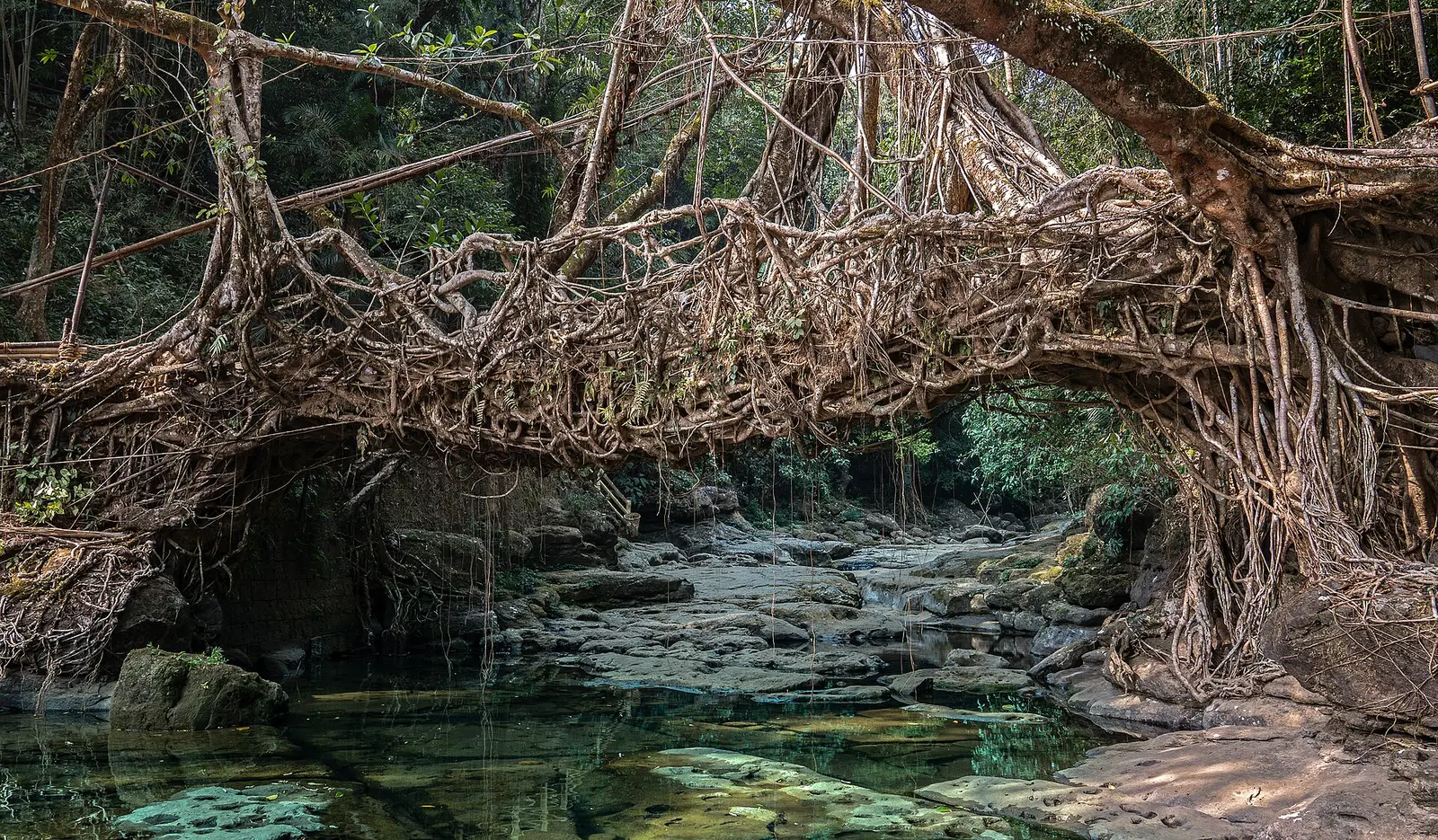
About 2 km from the village, this root bridge is made from the aerial roots of rubber fig trees trained across a stream over many years. Reaching it involves a short downhill walk on steps, far easier than the famous double-decker bridge at Nongriat near Cherrapunji.
Sky View
A tall bamboo platform built around a tree. On a clear day you can see across to the plains of Bangladesh. A small fee is usually charged; check on the spot.
Balancing Rock
A large boulder resting on a smaller stone, near the village. Locals believe it has been this way for centuries. It is a quick stop.
Dawki and Shnongpdeng
About 30 km away, the Umngot river is famous for water so clear that boats seem to float on glass in winter. Shnongpdeng, upstream, has quieter camping, kayaking and cliff jumping run by local operators. Boating is subject to river levels and local rules.
What food should you try in Mawlynnong?
Expect simple Khasi home food: rice, dal, local greens, chicken or pork, and fiery chutneys. Most meals are served by your homestay or a couple of small eateries in the village.
- Jadoh: rice cooked with pork or chicken and spices, the signature Khasi dish.
- Dohneiiong: pork cooked with black sesame paste.
- Tungrymbai: fermented soybean, pungent and an acquired taste.
- Pukhlein: a sweet fried rice-flour snack, good with tea.
Vegetarians can manage with rice, dal, vegetables and eggs, but tell your host in advance.
How to visit Mawlynnong responsibly
The village's cleanliness is the result of local effort, so the basic rule is to leave no trace. Carry your own litter out, use the dustbins and follow signboards.
- Pay the village entry and parking fees where charged; they fund upkeep. Amounts change, so check on arrival.
- Ask before photographing people or homes. Do not walk into private gardens.
- Avoid single-use plastic bottles; carry a refillable one.
- Keep noise down, especially in the evenings and on Sundays, when much of the village attends church.
Sample 2-day Mawlynnong plan
Two days is enough to see Mawlynnong and Dawki without rushing. Here is a simple plan starting from Shillong.
- Day 1: leave Shillong after breakfast and stop at viewpoints near Pynursla. Reach Mawlynnong by lunch, walk down to the Riwai root bridge, then climb Sky View for late-afternoon light. Evening village walk and dinner at your homestay.
- Day 2: early start to Dawki for a boat ride on the Umngot while the light is soft, then optional kayaking at Shnongpdeng. Drive back to Shillong by evening, or continue to Cherrapunji.
Mawlynnong fits well into a week in Meghalaya with Shillong, Cherrapunji and Dawki. See our Meghalaya tour package from Mumbai, or for something further off the map, read our guide to Ziro Valley. Our team can plan the whole trip including flights and cabs — send us your dates.